Introduction
I’ll be honest with you. When I first started looking into moving abroad, I thought the hard part was going to be the visa paperwork. Or finding a place to live. Or saying goodbye to people I’d known for years. Nobody told me I’d spend three weeks going down a rabbit hole trying to figure out how to move a couch across an ocean. That’s where the whole sea freight vs air freight moving thing comes in. And look – I’m not going to dress this up into something complicated because it really isn’t. But there are some things I wish someone had just told me plainly before I started making calls and getting quotes and second-guessing every decision. So that’s what this is. Plain talk. No fluff.
Understanding the Basics
Two options. That’s all you’re choosing between.
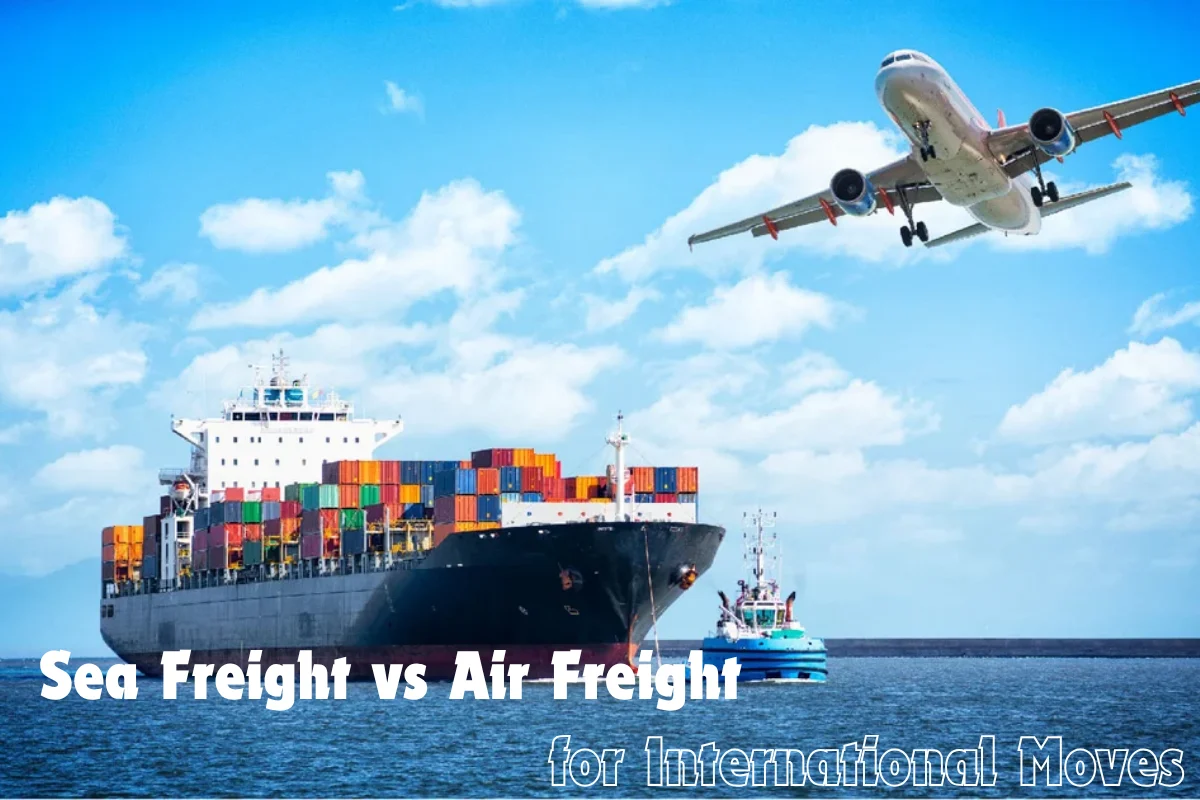
Sea freight – your stuff goes in a container on a ship. Air freight – your stuff goes on a plane.
Everything else in the sea freight vs air freight moving conversation – every factor, every trade-off, every “it depends” – comes from unpacking what those two sentences actually mean for your wallet, your timeline, and your sanity.
Cost Comparison: Budget Matters
Sea freight is cheaper. Sometimes embarrassingly so.
I’m talking about the kind of price difference that makes you feel a little silly for even considering air freight for a large move. When you’re shipping household goods overseas – real household stuff, not just a bag and a laptop – cargo ships exist to move large volumes of things, and that efficiency shows up directly in what you pay.
Air freight charges by weight and volume. Sounds straightforward until you’re standing in your kitchen realizing your blender, your cast iron pan, your coffee machine, and the box of books you told yourself you’d leave behind all add up to something that costs more to fly than it did to buy.
I’ve heard this story from multiple people. They estimated loosely, didn’t get a real quote until late, and ended up making rushed decisions about what to keep versus what to sell because the air freight number was completely out of range.
Quick breakdown:
- Sea freight: Affordable – built for large household moves
- Air freight: Adds up frighteningly fast – only practical for small shipments
In the sea freight vs air freight moving cost conversation, sea freight wins for anyone moving a real household. That’s just how the numbers work. At Allied Movers, we see this play out with clients regularly – the cost difference is rarely close.
Speed: How Fast Do You Need Your Items?
Here’s where you have to be really honest with yourself about your situation.
Air freight is fast. Two to seven days in most cases. There’s something almost surreal about your belongings arriving before you’ve even finished unpacking your suitcase.
Sea freight does not care about your schedule. Three to eight weeks is the range people talk about, but that’s the clean version. Customs holds happen. Port delays happen. Weather happens. The realistic version sometimes stretches longer than that, and the shipping company’s customer service line will be very polite and very unhelpful when it does.
Typical timelines:
- Air freight: 2-7 days
- Sea freight: 3-8 weeks (treat the longer end as your real baseline)
But here’s the question nobody actually asks themselves properly – what does my day-to-day life look like while I’m waiting?
Not in theory. Actually.
Are you moving into a furnished place? Do you have kids who are already struggling with the upheaval and need their things around them sooner rather than later? Are you starting work immediately and need your home set up to function? Or are you going to be so busy those first weeks that you wouldn’t even notice your boxes hadn’t arrived yet?
Your answers to those questions matter more than anything else in the sea freight vs air freight moving decision. Because six weeks without your belongings feels very different depending on your circumstances. For some people it’s genuinely fine. For others it’s a quiet misery they didn’t see coming.
Volume and Capacity
This one tends to make the decision before you’ve finished thinking about it.
Ships are built to carry enormous amounts of cargo. That’s not a selling point – it’s just their fundamental design. When you’re shipping household goods overseas and you’re moving years worth of accumulated life – furniture, appliances, the stuff that took a long time to collect and would cost a fortune to replace – sea freight handles all of it without breaking a sweat.
Planes aren’t built that way. Hard weight limits, hard volume limits, and pricing structures that punish you for every kilogram over the threshold. Your sofa is not getting on a plane at any price that makes sense.
Best use cases:
- Sea freight: Full household moves, large furniture, heavy or bulky items
- Air freight: A few boxes, documents, electronics, things you need immediately
Honestly, if you’re looking at a full home’s worth of belongings, sea freight vs air freight moving stops being much of a debate at this point.
Flexibility and Convenience
Air freight is more flexible. Flights leave constantly, adjustments are easier, and the whole process tends to have fewer moving parts.
Sea freight is rigid. Ships leave when they leave. If you miss a departure window you’re waiting for the next one. Port backlogs are real. Customs processing varies wildly by country and by what’s in your container. And when you’re already managing the enormous cognitive load of an international move, a shipping delay that stretches your timeline by two weeks lands much harder than it sounds right now.
But sea freight does give you choices worth knowing:
- Full Container Load (FCL) – your own container, entirely yours
- Less than Container Load (LCL) – your shipment shares space, lower cost
These options – both offered by Allied Movers – make shipping household goods overseas by sea more practical across a wider range of move sizes than people initially assume. LCL especially is useful when you’ve got too much for air but not enough to justify filling a whole container.
Safety and Handling
Straightforward answer: both are safe.
The longer answer is that they carry different risk profiles.
- Air freight: Short journey, minimal handling, low damage risk
- Sea freight: Long journey, more handling at multiple points, marginally higher risk – particularly for anything fragile
What actually determines whether your things arrive intact, though, is packing quality. Not method. A properly packed box handles a six-week sea voyage without issue. A poorly packed one gets damaged in two days of air freight. When shipping household goods overseas, pack as if things will be handled carelessly – because sometimes they will be and you’d rather not find out after the fact.
Environmental Impact
Cargo planes consume a staggering amount of fuel relative to what they carry. Sea freight moves far more per unit of emissions. It’s not even a particularly close comparison.
If that factors into how you make decisions – and for a lot of people it genuinely does, especially for a move this significant – it’s a real point in sea freight’s favor in the sea freight vs air freight moving conversation. Not a small print footnote. An actual reason.
What Should You Choose?
I’ll just tell you what I’d tell a friend.
Go sea freight if:
- You’re moving a full household
- You’re watching your budget and the cost difference is meaningful to you
- Your first weeks abroad can work around a longer wait
Go air freight if:
- You have specific things you genuinely need within days of arriving
- Your shipment is small enough that air pricing doesn’t hurt
- Speed is worth more to you than savings right now
And the option most people overlook completely: do both. Ship the things you actually need immediately by air – your laptop, enough clothes to function, whatever your children need to feel settled. Send everything else by sea. Total cost usually comes out well below shipping everything by air, and you solve the “I need something now” problem without paying for it across your entire shipment. For many people this split is the most sensible way to approach shipping household goods overseas and the numbers tend to support it once you actually run them. It’s an approach the team at Allied Movers often recommends once clients see the numbers side by side.
Tips for a Smooth International Move
Things that actually help, from people who’ve done this:
- Declutter harder than feels necessary before you pack – you pay to ship every single thing you keep
- Label boxes on every side, not just the top – boxes get stacked and turned
- Travel documents, contracts, anything irreplaceable – carry these yourself, always
- Read up on customs rules for your destination country before you pack, not mid-process
- Pay for experienced international movers if you can stretch to it – the difference in execution is real
Moving internationally rewards preparation more than almost anything else does. That applies to shipping household goods overseas as much as every other part of the process. Allied Movers has seen firsthand how much smoother things go when clients come in prepared.
Common Mistakes to Avoid
The ones I hear about most often:
- Planning around the optimistic sea freight timeline and being genuinely caught off guard when it runs longer
- Getting a loose air freight estimate and not running the real numbers until it’s too late to adjust
- Leaving customs research until someone else makes it your urgent problem
- Under-packing fragile items because dealing with it properly feels like too much effort in the middle of everything else
None of these are hard mistakes to avoid. They just require thinking ahead – which is exactly what the sea freight vs air freight moving decision punishes you for not doing.
Final Thoughts
You know your situation better than any article does.
What I can tell you is this – sea freight is the backbone of most sensible international moves. It’s affordable, it handles volume, and for most people with a real household to move, it’s the obvious answer once you see the cost comparison clearly.
Air freight earns its place for small shipments, urgent needs, and the essentials you genuinely can’t wait weeks for.
And splitting the two? That’s what a lot of experienced movers quietly do and don’t always advertise – because it sounds complicated until you realize it’s actually just common sense applied to shipping household goods overseas. At Allied Movers, it’s one of the first things we walk clients through.
Get the logistics right and you free up mental space for everything else this move involves. And there’s plenty of everything else.
Do it properly. It’s worth it.
Frequently Asked Questions
1. What is the main difference in sea freight vs air freight moving?
Sea freight is slower and cheaper, while air freight is faster but more expensive.
2. Which option is better for shipping household goods overseas?
Sea freight is better for large shipments, while air freight suits smaller, urgent items.
3. How long does sea freight vs air freight moving take?
Air freight takes a few days, whereas sea freight can take several weeks.
4. Is sea freight vs air freight moving more cost-effective?
Sea freight is generally more cost-effective for shipping household goods overseas.
5. Can I combine sea freight vs air freight moving for relocation?
Yes, many people use air freight for essentials and sea freight for the rest. Allied Movers can help you plan the right split for your specific situation.